


Some of the most profound life lessons are not delivered as instructions or lectures. They come quietly, in the rhythm of daily life, in small gestures, and in the patient attention of someone who chooses to lead by example. In many multigenerational stories, grandparents occupy a unique space in children’s lives, neither authoritarian nor peer, yet profoundly influential. Grandpère, as a literary and emotional figure, embodies this art of guidance: teaching without teaching, mentoring without imposing, and shaping a child’s understanding of the world through presence and modeling rather than explicit instruction.
Mentorship Beyond Words
Traditional teaching relies on words: rules, explanations, admonitions, and moral lessons. Grandpère demonstrates that mentorship can exist beyond words. His guidance is often silent, allowing children to observe, explore, and internalize values without pressure.
This approach respects the child’s autonomy. When adults step back from constant instruction, they create a space for children to experiment, make mistakes, and discover for themselves. It is in this space that curiosity thrives, resilience forms, and ethical awareness grows organically. Grandpère’s mentorship shows that sometimes, the absence of lecturing is the most powerful form of teaching.
Visit: https://michelledahlbooks.com
Modeling as a Form of Instruction
Children are perceptive observers. They notice not only what adults say but how adults act. Grandpère teaches through modeling, a form of mentorship where behavior communicates lessons more effectively than words ever could.
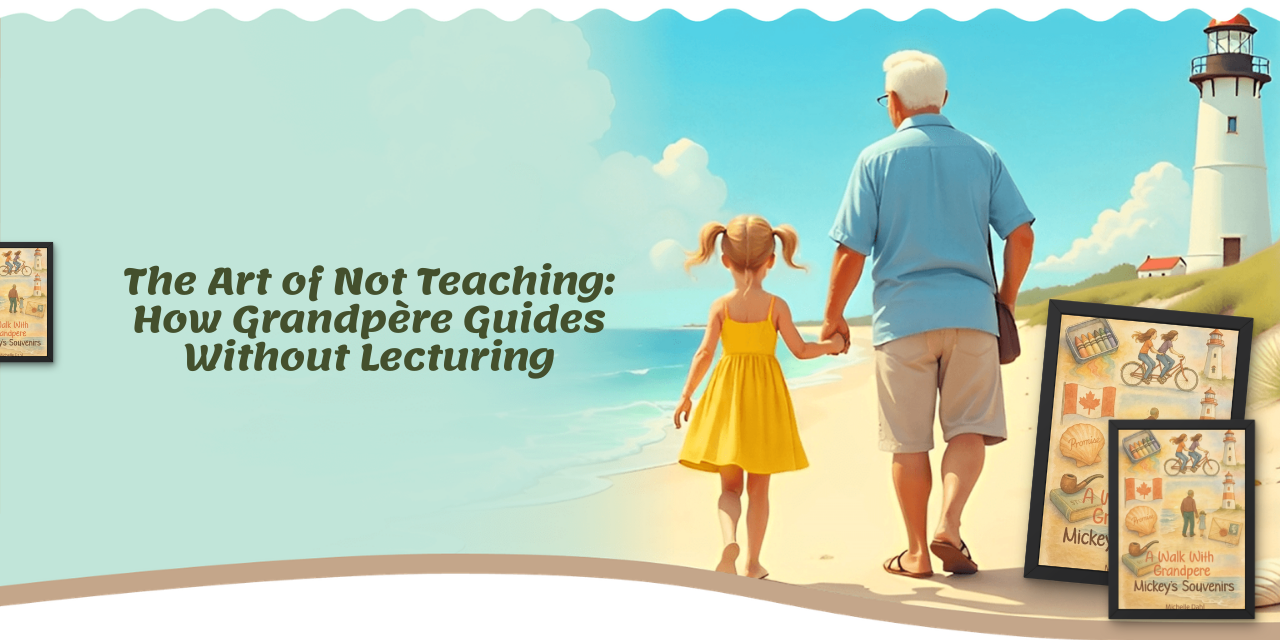
A simple walk along the beach, for example, becomes a lesson in patience and attentiveness. By observing how Grandpère moves, pauses, and interacts with the environment, the child learns how to slow down, notice details, and engage with the world thoughtfully. Through repeated exposure, these behaviors are absorbed almost subconsciously.
This method works because it aligns with the child’s natural learning style. Children do not always internalize verbal instructions, but they are attuned to patterns of behavior. When an adult demonstrates patience, curiosity, or kindness consistently, children begin to integrate these qualities into their own actions.
The Power of Presence
One of the most understated but impactful aspects of Grandpère’s guidance is presence. To be fully present with a child without distraction, judgment, or rush, is to communicate that the child’s experience matters.
Presence allows children to feel safe in exploration. They can ask questions freely, make mistakes, and experience wonder without fear of correction. The act of accompanying a child on a simple task, such as collecting shells, observing tides, or preparing a meal, becomes an emotional and cognitive apprenticeship. The lesson is embedded not in words but in the stability, attention, and care the child experiences firsthand.
Amazon: A Walk With Grandpere: Mickey’s Souvenirs
Learning Through Observation
Grandpère’s mentorship emphasizes observation over instruction. Children watch how he interacts with the environment, responds to challenges, and treats others. These observations create implicit lessons in emotional intelligence, empathy, and problem-solving.
For example, noticing how Grandpère carefully navigates slippery rocks or patiently untangles a fishing line teaches children adaptability and persistence. Witnessing how he responds calmly to unexpected events shows children the value of emotional regulation. In this way, Grandpère transforms everyday moments into living classrooms, where lessons emerge naturally and memorably.
Encouraging Autonomy and Confidence
By avoiding constant lecturing, Grandpère fosters autonomy. Children are encouraged to make decisions, solve small problems, and follow their curiosity. This approach builds confidence because children learn to trust their judgment and abilities.
Unlike formal instruction, where the focus is on the “correct answer,” gentle mentorship prioritizes process over outcome. Children internalize that mistakes are part of learning, that exploration is valuable, and that their efforts matter regardless of immediate success. This mindset cultivates resilience and self-assurance qualities that extend far beyond childhood.
The Role of Subtle Guidance
Guidance without lecturing does not mean absence of influence. Grandpère intervenes subtly when needed, steering gently rather than directing overtly. He offers questions instead of commands, suggestions instead of solutions.
This subtlety respects the child’s agency while still providing structure. The child learns to weigh advice, consider consequences, and make thoughtful choices. Over time, these experiences teach decision-making, responsibility, and ethical reasoning lessons that are far more lasting than any lecture could convey.
The Emotional Dimension of Non-Instructional Teaching
Grandpère’s approach also nurtures emotional development. Children learn empathy, patience, and self-regulation by observing and sharing in his calm presence. They witness how emotions can be expressed, managed, and integrated into daily life without drama or overreaction.
This quiet mentorship allows children to develop emotional literacy organically. They internalize lessons about handling frustration, celebrating small successes, and noticing the needs of others. These skills are foundational to resilience, social competence, and lifelong well-being.
Why This Approach Matters
In a culture that emphasizes structured learning, measurable outcomes, and verbal instruction, the art of not teaching offers a counterbalance. It reminds us that some of the most important lessons on how to move through the world with patience, curiosity, and integrity cannot be quantified or graded.
Grandpère demonstrates that mentorship is not about controlling a child’s development but about providing the environment, example, and presence that allow growth to unfold naturally. Children guided in this way often carry forward not only knowledge but also the habits, attitudes, and emotional skills necessary to navigate life successfully.
Final Thought: Lessons Without Lectures
The art of not teaching is subtle but powerful. Through modeling, presence, gentle guidance, and observation, Grandpère shows that children can learn deeply without being instructed directly. These lessons are integrated slowly, naturally, and meaningfully, forming the foundation of emotional intelligence, autonomy, and resilience.
By guiding without lecturing, mentors like Grandpère provide children with something far more enduring than answers: they provide the ability to explore, reflect, and grow independently, carrying the wisdom of a lifetime into every step of their own journey.